How to test water quality at home in 2026.
Five ways to check what's actually in your drinking water — strips, TDS pens, reagent kits, certified lab panels, and the new generation of solid-state spectral sensors. Here's what each one measures, what it misses, and when to reach for which.
What "water quality" actually means
"Quality" isn't one number. A useful at-home test covers six families of measurements, and most consumer tools only reach two or three of them:
- pH — acidity. Healthy drinking water sits between 6.5 and 8.5.
- Hardness — dissolved calcium and magnesium. Affects taste, scaling, and soap performance.
- Residual chlorine — disinfectant left after treatment. Below 0.2 ppm at the tap and re-contamination risk climbs.
- TDS — total dissolved solids. A volume number, not an identity number.
- Heavy metals — lead, copper, arsenic. The ones that hurt at parts-per-billion levels.
- Organics — TOC, COD, disinfection byproducts. Invisible to strips and TDS pens.
Any test that only returns "TDS = 240 ppm" gives you one of those six. That's not a quality reading; it's a single data point on a spreadsheet that needs five more columns.
The TDS trap: a low number isn't "safe"
Total dissolved solids is the most misunderstood number in home water testing. A TDS pen measures electrical conductivity, converts it to ppm, and reports a single total. It tells you how many ions are in the water — not which ions, and nothing about anything that isn't ionic.
This creates a logic trap. Reverse-osmosis demineralized water reads 10–20 ppm and scores "excellent" on every TDS chart — yet may still carry trace volatile organics (VOCs) or disinfection byproducts that slip through the membrane. A natural spring water reading 300 ppm scores "poor" on the same chart — yet is perfectly safe, even beneficial, because the dissolved solids are calcium, magnesium, and bicarbonate. Low TDS does not mean safe. It means few ions.
Bacteria, lead at 15 ppb, arsenic at 5 ppb, trihalomethanes, and pesticide residues all read as zero on a TDS pen — they are either non-ionic or present at concentrations far below what conductivity can resolve. Treat TDS as a stability indicator (has my supply changed?) and a softener check, never as a safety verdict.
This is where spectral absorption adds a layer TDS pens physically cannot. UV-Vis absorbance at 254 nm correlates with dissolved organic carbon (DOC) and chemical oxygen demand (COD) — the families of compounds that include disinfection byproducts, pesticide metabolites, and natural organic matter. A spectral sensor that reports UV254 alongside TDS gives you the inorganic total and the organic load in the same scan — covering two of the six measurement families instead of one.
The four classic at-home methods
1. Test strips
Dip a strip into a glass of water, wait sixty seconds, match the color pads to the chart on the bottle. Cheap (under $0.20 per test), portable, and the right starting point for first-time testers. The trade-off is resolution: each pad gives a three-or-four-step color band, so "pH 6.5–7.5" or "free chlorine 0.5–1.0 ppm" is as tight as you get. Strips also degrade with humidity — replace the bottle annually.
2. TDS pens
A $20 TDS pen measures electrical conductivity and converts it to ppm. It's a fast screening tool — useful for spotting a sudden change in your tap supply or confirming an RO system is still working. It is not a quality measurement: 240 ppm of calcium bicarbonate (healthy mineral water) and 240 ppm of nitrate (regulated contaminant) read identically.
3. Liquid reagent kits
Pool-store and aquarium-grade reagent kits use titration drops or colorimetric vials. Accuracy lands at ±5–10% — meaningfully better than strips for free chlorine, calcium hardness, alkalinity, and cyanuric acid. Downsides: ten minutes per panel, reagents expire in 12–18 months, and the chemistry only covers a handful of parameters per kit.
4. Certified lab panels
EPA-certified labs are still the only credible answer for lead, arsenic, nitrates, PFAS, VOCs, and microbial pathogens. Mail-in kits cost $25 for a basic panel and run to $200+ for a comprehensive scan; turnaround is one to two weeks. Use them once a year for well water, after any plumbing work, or any time the EPA issues a notice for your utility.
Step-by-step: test tap water in five minutes
- Run the tap for two minutes. First-draw water has been sitting in your pipes overnight and reads higher for metals than the supply actually is. Flush a cold-water tap for 120 seconds before sampling.
- Fill a clean glass. Skip plastic — leaching biases pH and organics. Rinse a glass vessel three times with the same water before filling it.
- Strip first, then TDS. Use a multi-parameter strip for pH, hardness, free chlorine, and total alkalinity, then a conductivity pen for total dissolved solids. Record both readings with the date and time.
- Compare against EPA guidance. Target pH 6.5–8.5, TDS under 500 mg/L, and residual chlorine 0.2–4.0 ppm. Any reading outside the band is a flag for follow-up, not a verdict.
- Flag for follow-up. If two or more parameters drift, repeat the test at a different time of day. If they drift again, escalate to an EPA-certified lab panel for lead, copper, and coliform bacteria.
Spectral testing: the fifth option
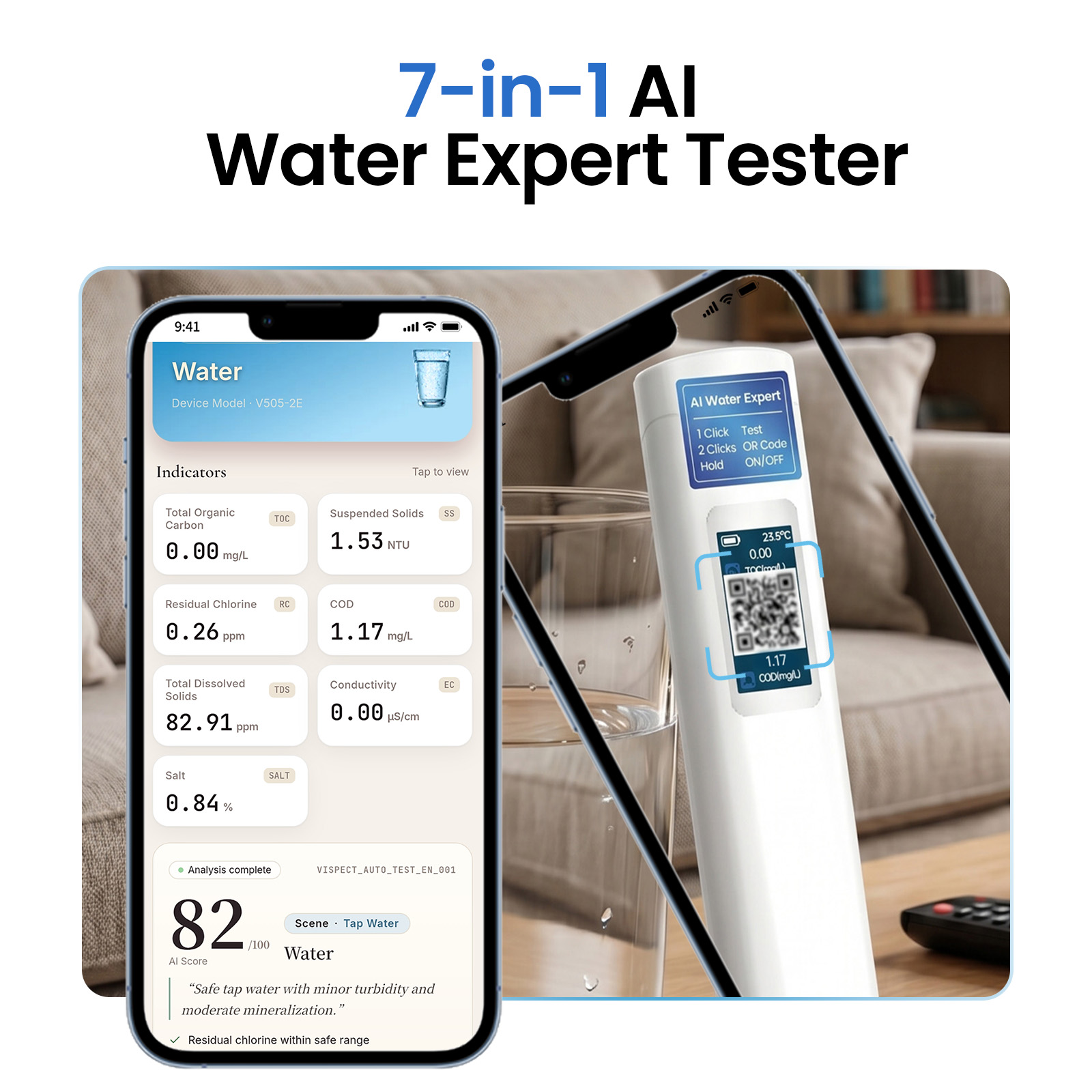
Strips, TDS pens, and reagents have been the at-home toolkit for thirty years because they were the only options. Spectral sensors are new. They use multispectral light — visible plus near-infrared bands — to read the molecular absorption signature of whatever is in the sample.
The practical difference is breadth and repeatability. A single five-second scan returns pH, residual chlorine, TDS, hardness, and organic load (TOC/COD) at the same time. There are no reagents to expire, no calibration that drifts. The optics are solid-state, so the device itself doesn't wear out.
Vispect builds one for drinking water (PureFlow) and one for pool and spa water (AquaSafe). Same engine, different calibration profiles.
How the four at-home methods compare
| Method | Target parameters | Limits of detection (LOD) | Speed | Consumable cost | Best use case |
|---|---|---|---|---|---|
| Test strips | pH, hardness, free chlorine, total alkalinity (4–6) | Color bands: ±0.5 pH, ±0.5 ppm Cl₂ | 60 s | ≈$0.20 / test | First-pass screening; no trend tracking |
| TDS pen (conductivity) | Total dissolved ionic solids only (1) | ±2% of reading, ~1 mg/L floor; blind to non-ionic species | 10 s | $0 after purchase | RO/softener performance and supply-stability checks |
| Liquid reagent kit | Free chlorine, alkalinity, calcium hardness, cyanuric acid (1–4) | ±5–10%, ~0.2 ppm Cl₂ | 5–10 min | ≈$0.50 / test; reagents expire in 12–18 months | Higher-accuracy single-parameter confirmation |
| Spectral sensor (Vispect) | pH, hardness, TDS, residual chlorine, iron, UV254 organic load (5–9) | mg/L class; no ppb-metal or microbial capability | ≈5 s | $0 — reagent-free, no calibration drift | Weekly/monthly multi-parameter trend logging |
| EPA-certified lab panel | Coliform/E. coli, lead, arsenic, nitrate, VOCs, PFAS (20–100+) | ICP-MS to sub-ppb: Pb 15 ppb action level, As 10 ppb MCL | 5–10 business days | $25–$200 per panel | Legal/health verdicts on potable safety |