Home wine analysis vs. professional labs.
ETS Labs, Vinquiry, and AWRI have run enological chemistry for decades. A new generation of spectral analyzers now puts the routine measurements in your cellar. Here's how the two compare on speed, cost per test, accuracy, and when each one is actually the right call.
The two workflows in one paragraph
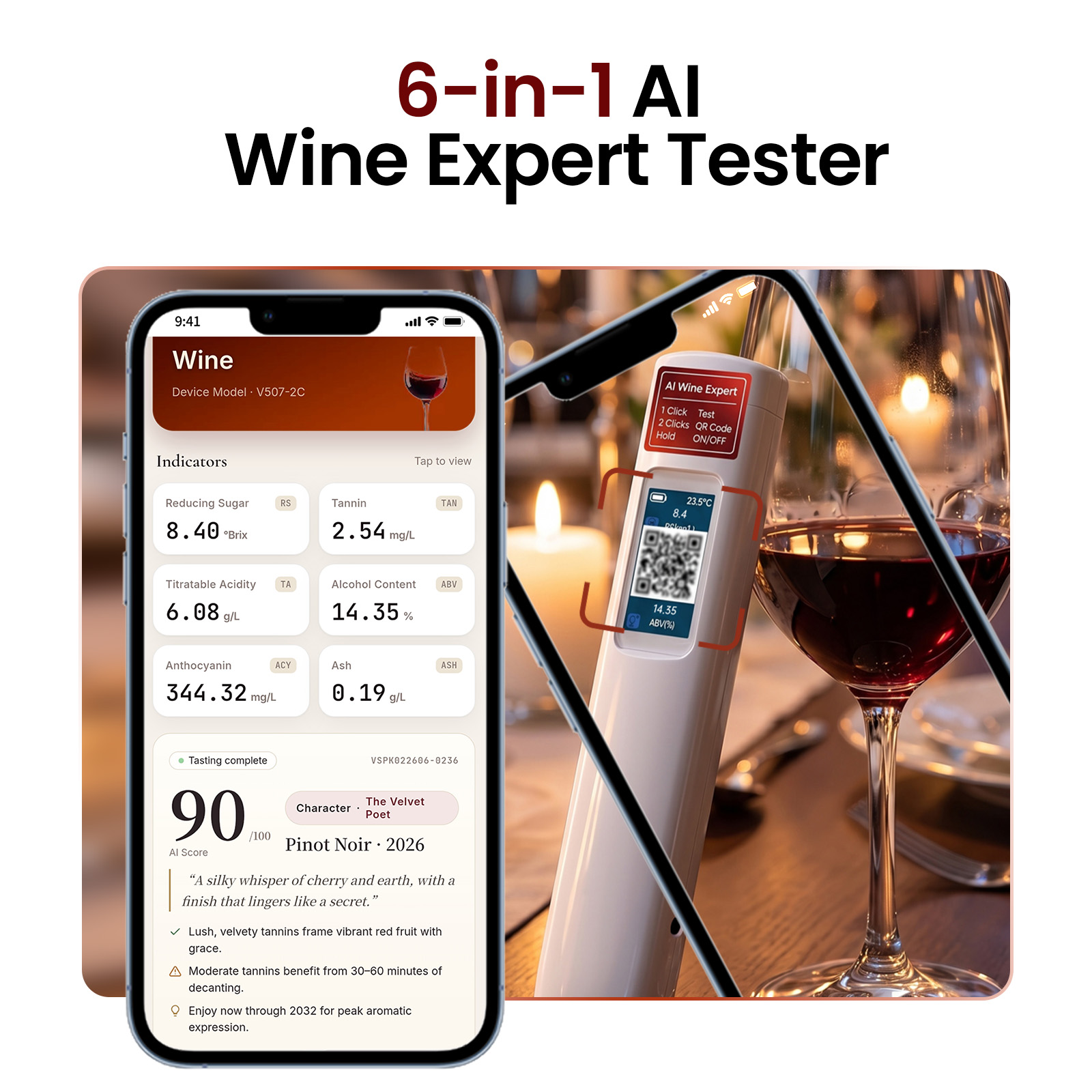
A professional wine lab like ETS Labs receives a 50–100 mL sample, runs wet chemistry, HPLC, or enzymatic assays, and returns a PDF in 2–10 business days at $15–$60 per parameter. A home spectral analyzer like VinoExpert reads a single drop with multispectral light, returns six parameters in five seconds, and costs nothing per scan after the device.
Side-by-side comparison
Where each one wins
Speed: home, by orders of magnitude
A fermentation can swing 2 °Brix in a day. Waiting a week for a lab number means you're correcting yesterday's wine. A five-second scan on the tank lets you make the call before lunch. Lab turnaround isn't slow because labs are inefficient — it's slow because the chemistry takes that long.
Cost per test: home wins on volume
ETS Labs charges around $40 for a 4-parameter screening panel and $150–$300 for a full pre-bottling panel. A cellar running 200 barrels with two checkpoints per barrel spends $20K+ a season on routine work. A $269 home analyzer covers the same routine measurements at zero per-scan cost.
Accuracy: labs still own the edge cases
Spectral analysis is excellent for residual sugar, total acidity, tannin, anthocyanin, ABV, and ash. It's not the right tool for free and total SO₂ (wet chemistry), Brettanomyces (microbial culture), or trace metals (ICP-MS). For those, ETS Labs and peers are still the standard.
Regulatory: labs only
TTB COLA submissions, export certifications, and contamination disputes all require results from a certified lab. A home analyzer is for operational decisions, not regulatory documentation.
The hybrid workflow that actually works
- Daily fermentation tracking → home analyzer. Sugar, TA, ABV, tannin extraction. Five seconds at the tank, logged automatically.
- Blending sessions → home analyzer. Read six parameters across every component lot in minutes instead of building a $2K lab order.
- Pre-bottling QA → professional lab. Full panel including SO₂, malic acid, microbial screen. One sample per blend, not per barrel.
- Regulatory & export → professional lab. Certified results for COLA, EU export, and any contamination question.
- Troubleshooting → professional lab. Off-flavors, suspected Brett, oxidation events. Labs catch what spectral can't see.
Cellars that adopt this split typically cut lab spend by 60–80% while running more frequent measurements than they did before.
Frequently asked questions
What does a professional wine lab like ETS Labs actually test?+
ETS Labs and peers (Vinquiry, AWRI, Gusmer) run full enological panels: residual sugar, total and volatile acidity, free and total SO₂, malic acid, alcohol by volume, pH, anthocyanins, tannins, Brettanomyces, and trace metals. Turnaround is 2–10 business days at $15–$60 per parameter.
How accurate is a home wine analyzer compared to a wine lab?+
A spectral home analyzer like VinoExpert lands within a few percent of lab reference values for residual sugar, total acidity, tannins, anthocyanins, ABV, and ash — the parameters that drive winemaking decisions day to day. Labs still win for SO₂, microbial counts, and trace metals where wet chemistry or chromatography is required.
How fast is a 5-second wine scan really?+
VinoExpert returns six parameters from a single drop in about five seconds, with no reagents and no sample prep. A lab sample takes 24–48 hours just to ship, then 2–10 business days for results. For a winemaker tracking a fermentation in real time, that gap is the difference between catching a problem and reading about it.
What does professional wine lab testing cost per sample?+
A basic 4-parameter panel at ETS Labs runs $40–$80. A full pre-bottling panel is $150–$300 per sample. A 200-barrel cellar testing twice during fermentation can spend $20,000+ a season. A home spectral analyzer pays for itself after a few dozen scans.
When should I still send samples to a professional lab?+
Send to a lab for regulatory submissions (TTB, export certifications), microbial diagnostics (Brett, lactic acid bacteria), SO₂ management at bottling, and any trace metal or contaminant screen. Use a home analyzer for the daily questions — sugar drop during fermentation, tannin extraction, acidity at blending, ABV at racking.
Can a home wine analyzer replace ETS Labs entirely?+
Not for everything — and that's not the goal. The point is to handle 80% of routine tracking on-site in seconds, and reserve the lab budget for the tests that actually need wet chemistry. Hybrid workflows reduce lab spend and shorten decision loops.