Wine Antioxidants, Anthocyanins & Tannins
The chemistry that decides whether your wine ages for a decade or fades in a year — and how to measure it in five seconds.
The phenolic family at a glance
Every meaningful antioxidant in wine is a polyphenol. Anthocyanins give red wine its color. Tannins give it structure. Flavan-3-ols and stilbenes round out the antioxidant capacity that protects flavor compounds from oxidation through years in bottle.
- Anthocyanins — water-soluble pigments from grape skins, peak absorbance near 520 nm.
- Tannins — proanthocyanidins from skins, seeds, and oak; bind proteins and pigments.
- Catechin / epicatechin — monomeric flavan-3-ols, building blocks of tannins.
- Resveratrol — stilbene, trace levels but well-known antioxidant.
Why anthocyanin tracking predicts aging
Free anthocyanins fade. Polymerized pigments — anthocyanins bound to tannins — last for decades. The ratio of total anthocyanin to polymeric pigment at the end of maceration is one of the strongest predictors of how a red wine will look at age ten. Wines pressed too early leave anthocyanins behind in the skins; wines pressed too late risk extracting bitter seed tannin.
Tannins: structure, astringency, antioxidant reserve
Tannins do three jobs: they bind salivary proteins (mouthfeel), they bind anthocyanins (color stability), and they consume oxygen (antioxidant reserve that protects fruit). A wine with 1500+ mg/L of well-extracted skin tannin and balanced anthocyanin can age fifteen years. A wine under 500 mg/L is built for early drinking — both are legitimate, but only if you know which one you've made.
Measuring antioxidants without reagents
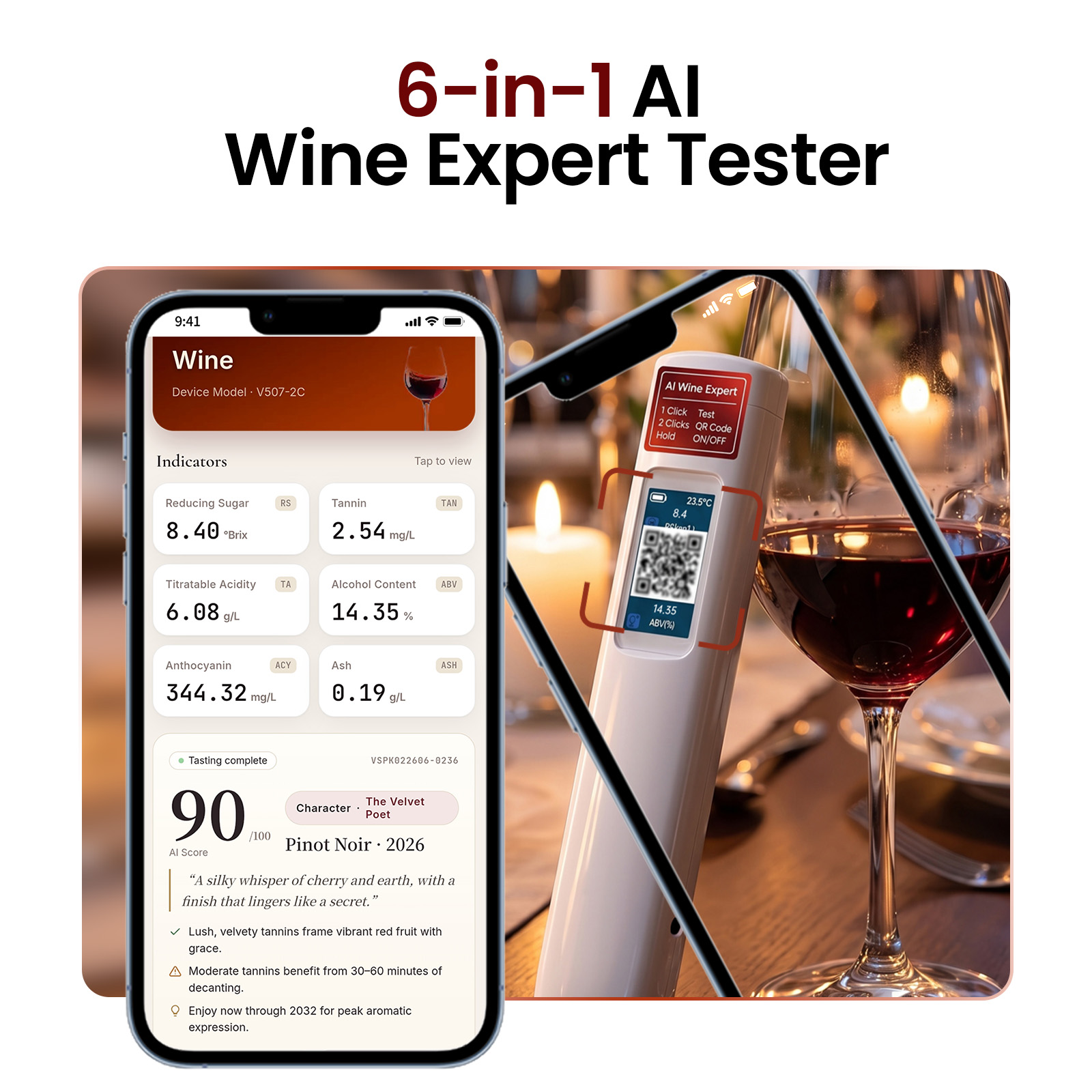
Lab references (Folin-Ciocalteu, methyl cellulose precipitation, pH-differential) are accurate but slow and reagent-heavy. Multispectral sensing reads absorbance across UV, visible, and near-infrared bands and reconstructs concentrations with a trained model. VinoExpert returns total anthocyanin, total tannin, and total phenolic indices in about five seconds from a single drop — no reagents, no waste, no shipping.
Practically, that means you can sample twice a day through maceration, every barrel at racking, and every blend candidate before committing — at a cost per measurement that makes lab-only workflows look extravagant.
Frequently asked
Measure what aging depends on
VinoExpert reads anthocyanins, tannins, and total phenolics from a single drop in five seconds. Reagent-free, repeatable, ready for the cellar.
See VinoExpert