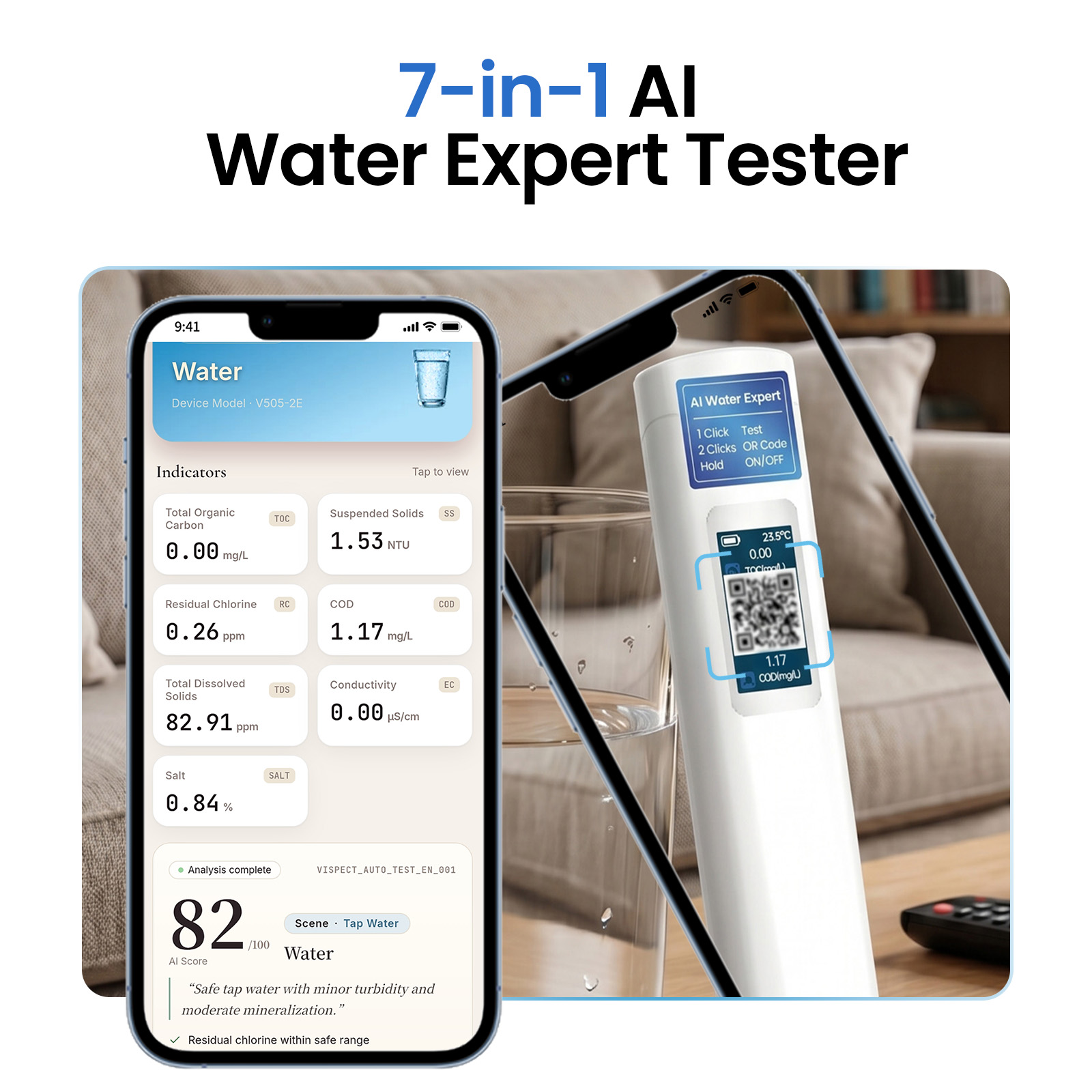
Well water testing without the guesswork.
About 43 million Americans get their drinking water from a private well, and none of it is checked by the EPA. Here's the split every well owner should run: routine on-site spectral screening for the minerals and organics that shift week to week, plus an annual certified lab panel for the microbial and heavy-metal contaminants that don't forgive a wrong answer.
Two tests, two jobs
Private well water changes with the seasons. Spring runoff pushes nitrate up. Summer drawdown concentrates iron and hardness. A new septic field two houses over can introduce coliform overnight. Testing once a year misses all of it.
The working split is simple:
- On-site spectral screening — pH, hardness, TDS, iron, residual chlorine, and organic load. Fast, repeatable, monthly. Catches drift.
- Annual certified lab panel — coliform, E. coli, arsenic, lead, nitrate confirmation, uranium, radon in the regions that need it. Slow, expensive, decisive. Confirms safety.
What to scan every month
pH and hardness
Well pH usually sits 6.0–8.5 depending on aquifer geology. A steady drop below 6.5 is a signal to pull a corrosion sample — acidic water leaches copper and lead from household plumbing. Hardness above 180 mg/L (10.5 grains) is what your softener is supposed to reduce; a rising post-softener reading means the resin is exhausted.
TDS and iron
TDS drift tells you the aquifer is either recharging (dropping) or concentrating (rising). Iron above 0.3 mg/L stains fixtures orange and clogs aerators; above 1 mg/L it's a taste problem. Both parameters shift on a monthly timescale — perfect for on-site testing, wasteful to mail to a lab.
Don't fall for the TDS trap. A low TDS reading means few dissolved ions — not "safe." Bacteria, lead at 15 ppb, arsenic at 10 ppb, and pesticide residues all read as zero on a conductivity pen because they are non-ionic or below its detection floor. Reverse-osmosis water at 10 ppm and contaminated water at 10 ppm can look identical. That's why the spectral scan pairs TDS with UV254 organic load — the ion total plus the organic fingerprint together catch what TDS alone hides. Neither replaces the annual microbial and metals panel.
Nitrate and organics
Nitrate is the fastest-moving well contaminant in agricultural regions. The drinking-water limit is 10 mg/L as N; infant safety cutoffs are lower. A monthly screening for nitrate plus organic load catches runoff events before an annual lab test would.
What to send to a lab every year
Total coliform and E. coli
The single most important annual test. Any detect is a fail — shock-chlorinate the well, retest, and if it persists, inspect the wellhead seal and casing. Coliform is microbial; there is no reliable at-home spectral method for it.
Heavy metals
Arsenic, lead, copper, and — in specific geologies — uranium. These matter at parts-per-billion levels and require ICP-MS analysis. Budget $50–$150 for the panel; do not skip.
Radon (regional)
If your county sits on granite bedrock or a known uranium belt, add a radon-in-water test. The proposed EPA MCL is 4,000 pCi/L; anything above that changes what treatment you need.
A monthly well water routine
- Sample cold, not hot. Hot-water lines pick up sediment from the heater and bias iron and hardness readings. Always draw from a cold tap.
- Flush for two minutes. Stagnant water in the plumbing is not representative of the aquifer. Run the tap 120 seconds before filling the sample vessel.
- Run one spectral scan. Capture pH, hardness, TDS, iron, residual chlorine and UV254 organic load in a single five-second reagent-free read.
- Log the reading. Record the date and every value. The trend line, not the absolute number, is what surfaces problems before a taste or color change does.
- Escalate on drift. Two consecutive months of movement outside your baseline is the trigger for an off-cycle EPA-certified laboratory panel.
On-site screening vs. certified lab panel
| Approach | Target parameters | Limits of detection (LOD) | Turnaround | Cost | Best use case |
|---|---|---|---|---|---|
| Monthly spectral screen | pH, hardness, TDS, iron, residual chlorine, UV254 organics | mg/L class; no microbial or ppb-metal capability | ≈5 seconds | $0 per test, reagent-free | Trend tracking, softener/filter performance, early drift alerts |
| Annual certified lab panel | Total coliform / E. coli, arsenic, lead, uranium, nitrate, radon, VOCs | ICP-MS sub-ppb: As 10 ppb MCL, Pb 15 ppb action level, nitrate 10 mg/L as N | 5–10 business days | $50–$150 per panel | Health and legal verdicts on potable safety |