Drinking Water Safety 8 min read Reviewed by Vispect Labs Houston, TX
Spectral sensing vs. TDS meters: what one number hides.
A TDS pen is the most common water tester in the world — and the most misunderstood. It answers one narrow question honestly: how much dissolved mineral is in this water? Everything else people want to know, it cannot see.
Electrical conductivity of dissolved ions — a single number
Absorption across many wavelengths — a molecular fingerprint
Organic matter (TOC/COD)
Invisible — sugar, algae and most organics barely register
Detected directly from UV-visible absorption signatures
Metals like iron or lead
Ionic metals add to the number; neutral particles do not
Colored/oxidized species show up; ppb-level traces still need a lab
Result format
One ppm figure, no context
Parameter-by-parameter readings plus a trend history
Best use
Quick sanity check on RO membranes and filters
Screening organic load, aging water and chemistry shifts
Failure mode
A 'good' low number on contaminated water — false comfort
Cannot see microbes; lab tests still needed for safety sign-off
The TDS trap
Conductivity is a real measurement — it is just routinely over-read. A glass of distilled water with dissolved sugar can read lower TDS than a clean mineral spring, because sugar barely conducts. Algae byproducts, humic acids from decaying leaves, and many industrial chemicals behave the same way: present, sometimes at meaningful levels, and electrically silent.
That is how "the TDS pen says it's fine" becomes a false sense of security. The number can be low and stable while organic load quietly climbs — exactly the change you would want to catch early in a filter that is aging or a tank that is stagnating.
How multispectral light sees TOC and COD
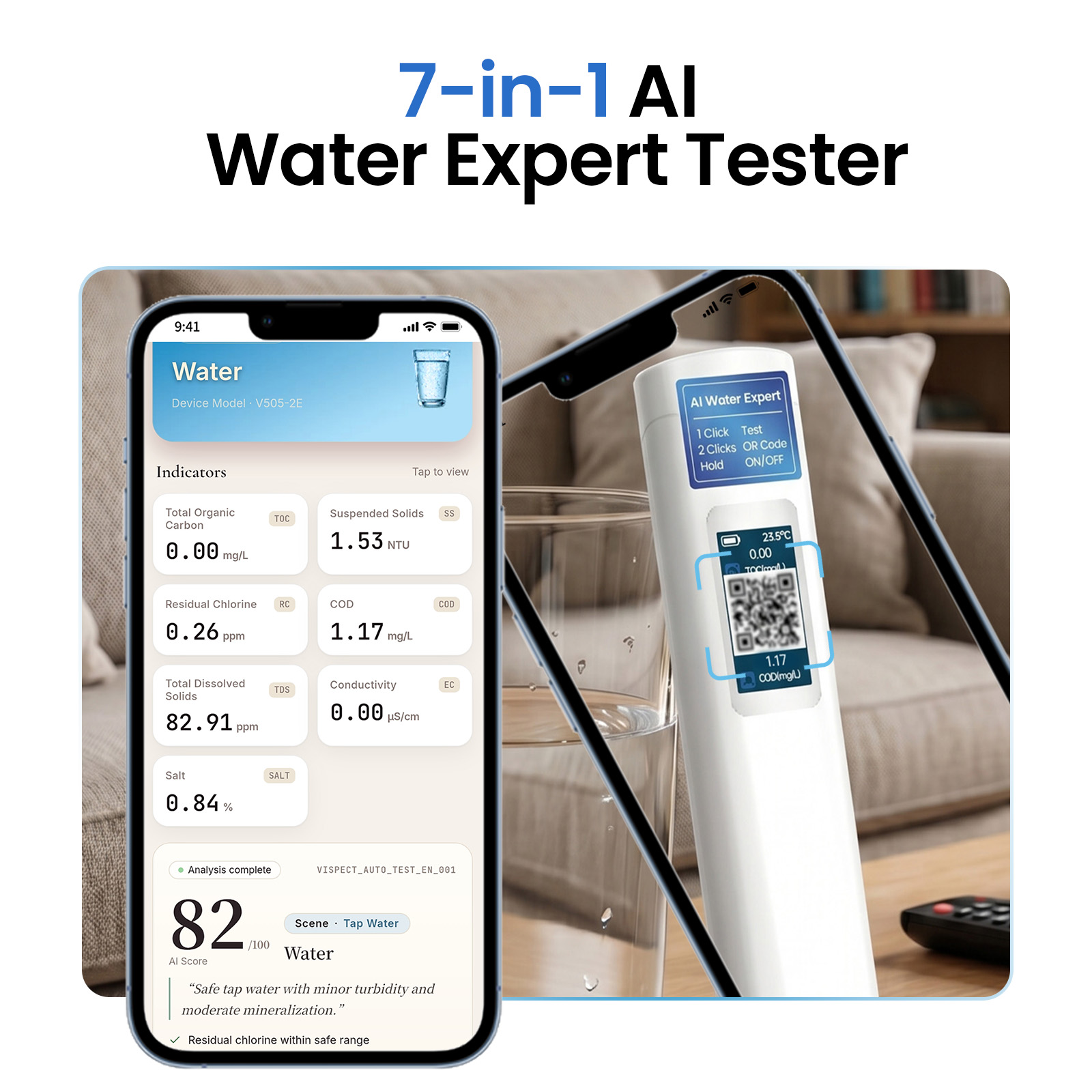
Organic molecules absorb ultraviolet and visible light at characteristic wavelengths. Pass a known spectrum through a water sample and the pattern of what comes out — the molecular fingerprint — correlates with total organic carbon and chemical oxygen demand, the two standard measures of organic load used in professional water analysis.
Because the reading is optical, it takes seconds, needs no reagents, and can be repeated daily without consumables. That is what turns water testing from an occasional chore into a trend line — and trend lines are how you catch a failing filter weeks before taste or cloudiness would tell you.