Pool water testing without the strips.
A pool is a chemistry set that the weather keeps stirring. Sunlight strips chlorine, rain dilutes alkalinity, and every swimmer adds organic load. Here's what to measure, how often, and why a reagent-free spectral scan beats squinting at a color chart.
The six numbers that run your pool
Swimmer comfort and chlorine efficiency. Below 7.2 corrodes surfaces and stings eyes; above 7.8 chlorine loses most of its kill power.
The active sanitizer. Anything under 1 ppm is an open door for algae and bacteria.
The buffer that keeps pH from bouncing. Fix alkalinity before chasing pH.
Too low and the water leaches calcium from plaster and grout; too high and you get scale.
UV shield for chlorine in outdoor pools. Too little burns chlorine off; too much locks it up.
Rising dissolved solids and organic load explain chlorine demand that chemistry alone can't.
Ranges above are the widely used industry targets — confirm against your local health code and your builder's guidance for the surface you have.
Test kits, compared
Strips
Cheapest and fastest. Read by eye against a printed chart, which means two people get two answers. Pads oxidize once the bottle is opened, so accuracy quietly decays over a season. Good for a spot check, poor for a trend line.
Drop / reagent kits
More accurate than strips when done carefully, especially the FAS-DPD chlorine titration. The cost is time, consumables, and a shelf of reagents with expiry dates — plus liquid waste every single test.
Spectral scanning
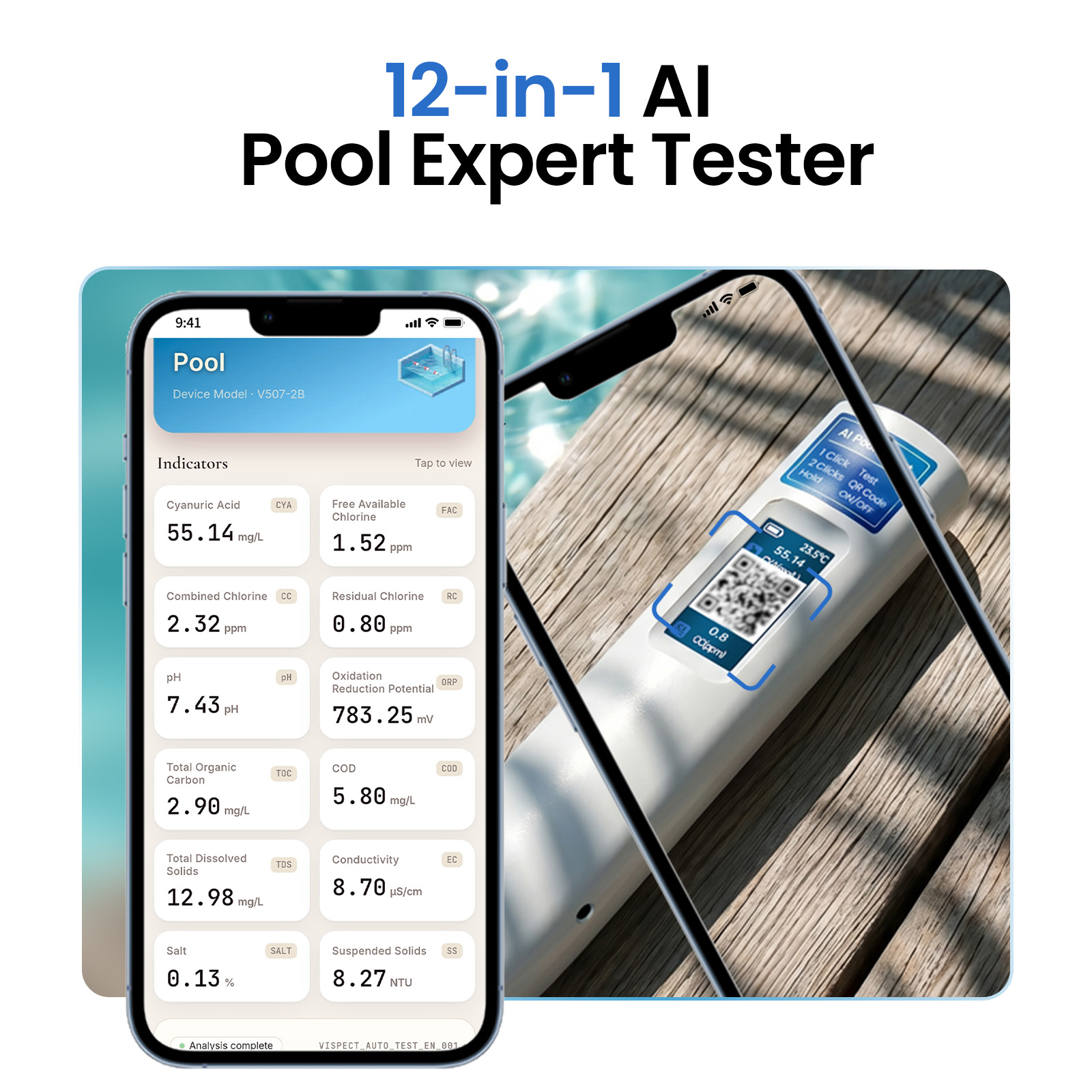
An optical read of how the water absorbs light across hundreds of wavelengths. No reagents, no color matching, no consumables — one five-second scan returns numeric values you can log week over week. That log is what turns "the pool looks fine" into an early warning.
Certified lab
Reserve it for what home testing can't answer: microbial contamination after a fecal or vomit incident, suspected metals staining, or a dispute over fill-water quality. Slow and expensive, but decisive.
Pool testing methods at a glance
| Method | Target parameters | Accuracy / LOD | Speed | Consumable cost | Best use case |
|---|---|---|---|---|---|
| Test strips | pH, free chlorine, alkalinity, hardness, CYA (4–7) | Visual color bands, ≈±0.5 pH / ±0.5 ppm Cl₂; degrades once opened | 60 s | ≈$0.15 / test | Quick spot check between real tests |
| FAS-DPD / drop kit | Free & combined chlorine, pH, alkalinity, calcium hardness, CYA | ±0.2 ppm chlorine with careful titration | 5–10 min | ≈$0.40 / test; reagents expire | Accurate chlorine and shock-dose calculations |
| Spectral scan (AquaSafe) | pH, chlorine, alkalinity, hardness, TDS, organic load (5–8) | Numeric mg/L-class reads; no microbial capability | ≈5 s | $0 — reagent-free | Weekly logging and chlorine-demand trend detection |
| Certified lab | Bacteria (E. coli, Pseudomonas), metals, fill-water full panel | Culture-based microbiology; ICP-MS sub-ppb metals | 3–10 business days | $40–$150 per panel | Post-incident clearance and staining disputes |
A weekly pool testing routine
- Sample away from returns and skimmers. Draw elbow-deep, mid-pool, on the shaded side — not where you just poured chemicals.
- Test pH and free chlorine first. They move fastest and drive every other decision. Target pH 7.2–7.8 and free chlorine 1–3 ppm.
- Fix alkalinity before pH. Adjusting pH while total alkalinity sits outside 80–120 ppm means doing it again next week.
- Retest after a full turnover. Allow four to eight hours of circulation before judging whether a dose worked.
- Log every reading. The slope matters more than the absolute value. Rising chlorine demand at a steady dose is the earliest algae signal you get.