Spotting counterfeit bourbon & ABV drift.
The secondary market rewards fakes: allocated bottles, thin paperwork, and buyers who judge with their eyes. Most counterfeits fail on measurable details long before they fail on taste.
Six signals worth checking
A sealed bottle should sit within a point of its label. A multi-point gap points to dilution, a refill, or long-term evaporation past a compromised closure.
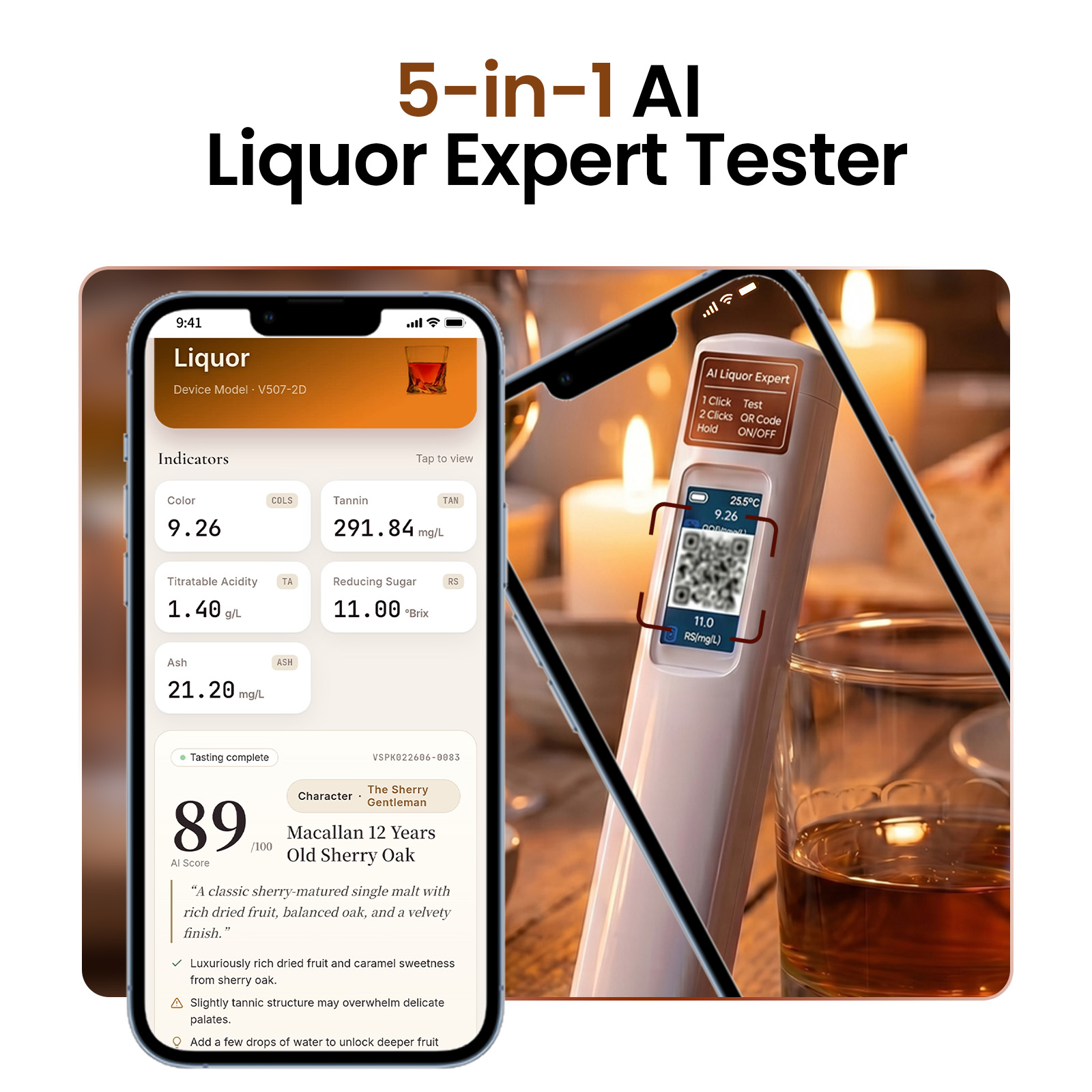
Caramel colouring can imitate age in the glass. Optical absorbance across the visible band separates 'dark' from 'developed'.
Straight bourbon has no added sweetener. A measurable sugar signal in something labelled straight is a red flag.
Sudden fill drop, tax-strip damage, glue residue, or a cork that spins freely are the classic refill tells.
Font drift, wrong bottle-mould code, misprinted lot numbers, and modern barcodes on supposedly old stock.
Auction history, receipts and photographs. No paperwork on a four-figure bottle is itself the finding.
Why ABV drift matters
Bourbon is bottled at a declared strength and, sealed properly, holds it for decades. Cork is the weak point. Stored warm, upright but dry, or lying on its side under high-proof liquid, the closure eventually leaks vapour — and because ethanol and water leave at different rates, the number in the bottle moves away from the number on the label.
A one-point difference is unremarkable. A five-point difference on a sealed bottle means something happened: heavy evaporation, a previous opening, or a refill with cheaper liquid topped to the shoulder. Measuring strength turns that from a hunch into a number you can put in front of a seller.
Where home screening stops
Used in the right order — packaging, provenance, then liquid screening — you eliminate most bad bottles cheaply and reserve lab spend for the genuinely ambiguous ones.